The School-Ready Models
A district doesn’t need one accommodation tool for every situation — it needs a device that fits into existing budget categories, satisfies compliance requirements, and works for the range of students who actually need reading support, from a K-2 struggling reader to a 1:1-device high schooler with an accommodation plan.
Here’s what to actually evaluate before a scanner pen shows up in a purchase order.
| Model | Price | Setup | Best fit |
|---|---|---|---|
| Scanmarker Max Bundle | $319 | Standalone, no IT needed | The district-recommended pick for IEP/504 and structured literacy support |
| Scanmarker Max | $299 | Standalone, no IT needed | Same core reading support without the phonics card set |
| Scanmarker Pro | $249 | Connected, pairs to student’s issued device | Best fit for 1:1 device classrooms that already manage a laptop or tablet per student |
What a Purchasing Officer Actually Needs to Know
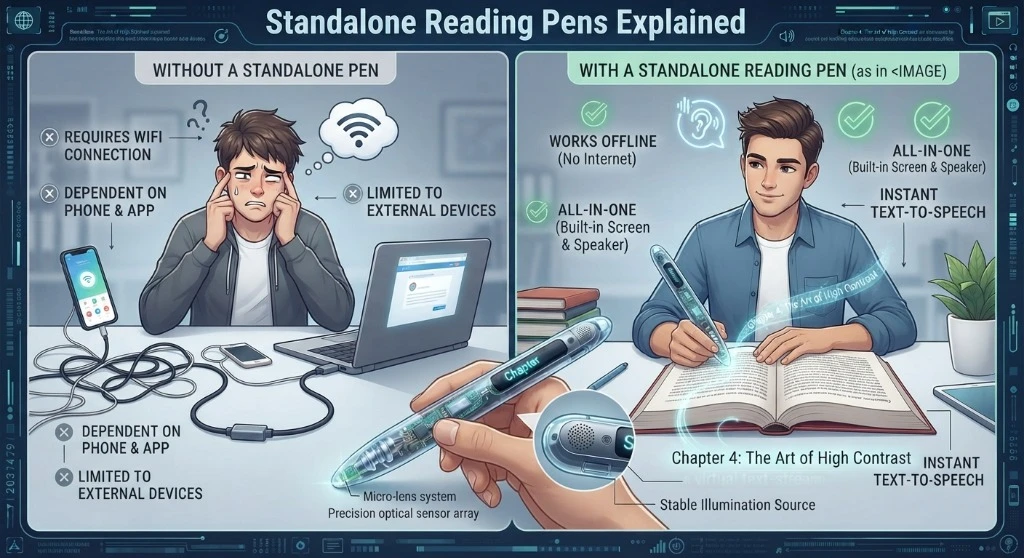
No laptop, no IT overhead — for the standalone models. Max and Max Bundle work independently of the school’s device fleet. No app to push through an MDM, no login, no software update cycle for IT to own. For a district weighing a device that has to be supported by an already-stretched IT team, that’s the practical difference between one more thing to manage and handing it to the student.
Exam-lock mode matters for accommodation compliance. When a reading pen is written into a student’s accommodation plan for use during testing, exam-lock mode disables translation and dictionary lookup so the pen only reads text aloud — nothing more than the approved accommodation. Max and Max Bundle include this; it’s worth confirming with any vendor whether their pen has an equivalent before a testing season depends on it.
Funding sources to actually check current eligibility on, not assume: IDEA Part B, Title I, Title III, and state-level assistive technology grant programs are the current-cycle funding paths worth checking against your district’s specific allocation — funding rules and deadlines shift year to year, so confirm current eligibility with your district’s finance office rather than relying on any vendor’s general claim, including ours.
Procurement mechanics. Purchase order, Net-30 terms, and W-9 documentation are standard for this category — ask any vendor directly whether they’re set up as an approved vendor for your specific procurement platform (e.g., ClassWallet or your state’s equivalent) before assuming compatibility.
FERPA and COPPA. A standalone reading pen with no login, no account, and no data leaving the device during normal reading use is generally the simplest profile from a student-data-privacy standpoint — but confirm this in writing from any vendor for your district’s compliance file rather than taking it as given.
Max Bundle vs. Max vs. Pro — the Actual Decision Tree
- Student has an IEP/504 specifying structured literacy support: Max Bundle.
- Student needs reading support without a specific phonics-content requirement: Max.
- Classroom already issues a laptop or tablet per student (1:1 device program): Pro — it pairs with the device already in the student’s hands rather than adding a second standalone tool.
Questions to Ask Before You Sign
- Does this pen require Wi-Fi or a paired device for basic read-aloud functionality?
- Is there an exam-lock or equivalent testing mode, and how is it activated/verified by staff?
- What is the actual current funding source eligibility for this device category in our state?
- What does procurement documentation (W-9, Net-30 terms, vendor registration) look like for our platform?
- What data, if any, leaves the device during normal use, and does that meet our FERPA/COPPA obligations?