
The Compliance Dilemma: Testing Integrity vs. Reading Access
Special Education Directors and Assistive Technology (AT) specialists operate under a rigorous legal mandate: ensure students with Specific Learning Disabilities (SLD), dyslexia, and processing impairments receive equal access to general education curriculum under the Individuals with Disabilities Education Act (IDEA) and Section 504 of the Rehabilitation Act.
Historically, providing read-aloud accommodations required human paraprofessionals or full laptop/Chromebook text-to-speech software. Both solutions present operational friction:
- **Human proctors** are costly, resource-intensive, and inadvertently create student dependency, discouraging autonomous self-advocacy.
- **Laptops and tablets** introduce internet connectivity, unapproved digital tools, AI assistance, and messaging vulnerabilities that compromise standardized testing integrity and trigger strict state exam disqualifications.
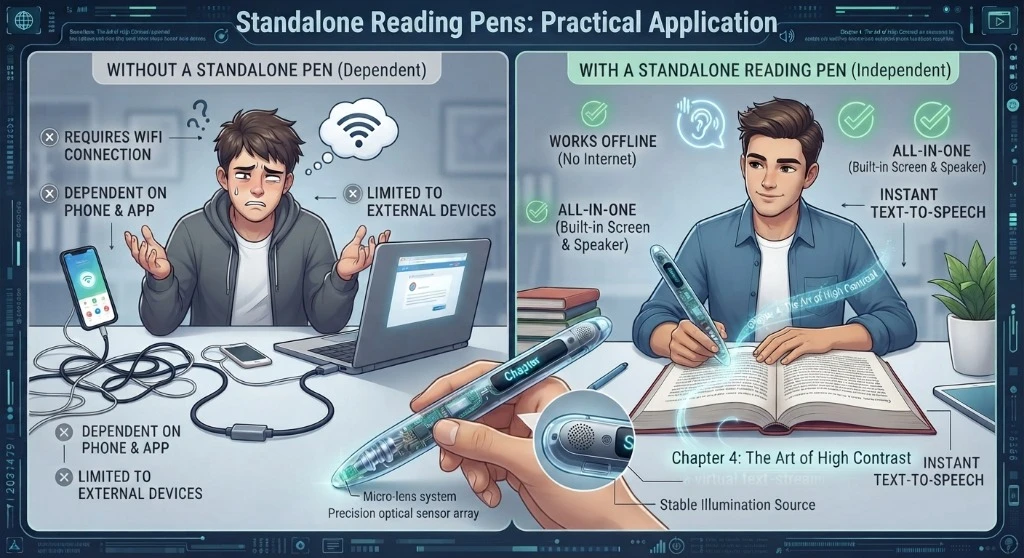
Standalone optical reading pens solve this dilemma by providing self-contained, audiotextual translation directly on physical paper—without network connectivity or external device access.
Testing Compliance: Exam-Lock Architecture Explained
Standardized assessment regulations (including state testing bodies, College Board for SAT/AP, and ACT guidelines) require that any assistive reading accommodation exclude unauthorized aids, particularly dictionary definitions, encyclopedias, and real-time translators.
The **Scanmarker Max ($299)** addresses testing compliance through a certified, PIN-protected **Exam-Lock Mode**:
- When engaged by an educator or testing coordinator, Exam-Lock completely disables the internal dictionary, translation engines, voice recorder, and Wi-Fi sync capabilities.
- The device's visual interface changes to a high-visibility locked indicator, allowing testing proctors to verify compliance from across the room at a glance.
- The pen operates strictly as a line-by-line optical character reader and voice synthesizer, mirroring the exact functional role of a human reader without human scheduling constraints.
Tiered School District Deployment Matrix
Successful district AT programs typically categorize deployment into two standardized hardware tiers based on grade band and student developmental goals:
| Criteria | Tier 1: Foundational Literacy (Grades 2–8) | Tier 2: Advanced & Secondary (Grades 9–12+) |
|---|---|---|
| Recommended Model | Scanmarker PAL ($179) | Scanmarker Max ($299) |
| Instructional Environment | Resource rooms, elementary general education, Tier 2/3 MTSS reading intervention | High school coursework, AP classes, vocational training, dual-enrollment college prep |
| Key Pedagogical Benefit | Single-purpose phonics text-to-speech with zero distractibility or internet access | Full touchscreen vocabulary building, offline multilingual support for newcomers, exam mode |
| Device Durability | Reinforced drop-resistant polycarbonate casing with recessed optical sensor | Sleek ergonomic form factor with scratch-resistant capacitive glass display |
| Testing Accommodation Fit | Approved for local assessments and non-dictionary IEP accommodations | Approved for high-stakes standardized assessments via PIN-locked Exam Mode |
Funding Pathways: IDEA Part B, Title I, and ESSER Transitions
Districts do not need to rely on general operating funds to equip resource rooms and 1:1 student accommodation kits. Standalone reading pens fall squarely under approved federal and state assistive technology funding categories:
1. **IDEA Part B (Section 611/619):** Appropriated specifically for assistive technology devices and services required to provide Free Appropriate Public Education (FAPE) to students with identified IEP accommodations.
2. **Title I, Part A:** Usable for schoolwide intervention strategies and targeted academic support programs to accelerate reading performance in economically disadvantaged schools.
3. **Title III (English Language Acquisition):** Supports multi-language standalone reading tools like Scanmarker Max for newly arrived English Language Learners (ELL) requiring dual-language decoding support.
Scanmarker for Schools provides 30-day classroom trial kits, district purchase order (PO) invoicing, and tiered volume pricing for accredited educational agencies.